malpractice
We probably have all heard of predatory journals. The phenomenon of ‘predatory conferences’ seems to be less-well appreciated. Hardly a day goes by that I do not receive emails like the one below:
________________________________________________________
Dear Dr. E Ernst ,
Good day!
After the success of Traditional Medicine-2018 in Rome, Italy, on behalf of the Organizing committee, we are delighted to invite you to be a speaker at our upcoming “3rd World Congress and Expo on Traditional and Alternative Medicine” (Traditional Medicine-2019) which will be held during June 06-08, 2019 in Berlin, Germany.
Traditional Medicine-2019 will focus on the theme “Natural and Scientific Approach for Treatment and Rehabilitation”…
_________________________________________________________
I have chosen this particular one because it refers to the success of a recent conference in Rome. This is a conference where I was a member of the organising committee and have been listed as a keynote speaker. Here is the original entry from the programme:
Keynote Forum 09:15-09:55
Title: Integrative Medicine: Hype or Hope? Ernst Edzard, University of Exeter, United Kingdom
And here is the strange tale how it all came about:
After receiving a barrage of similar invitations and having ignored them for months, I thought that maybe I am unnecessarily suspicious – perhaps these conferences are not as dodgy as they appear to be. So, I responded to one email and stated the usual things:
- I do not insist on a fee,
- I want my expensed paid,
- I need a topic that I feel comfortable with,
- I need to know who else is speaking,
- I must know who is sponsoring the event,
- the whole thing must fit into my time-table.
I got an enthusiastic response and, even though not all my questions were answered, they agreed to fund my travel and hotel costs with a lump sum of 300 Euro. They asked me to act as chair of the entire meeting and as ‘signing authority for the conference’ (I don’t know what this means) but I declined. Yet I wanted to see how the whole thing would play out. So, I accepted a keynote lecture, agreed to be a member of the organising/scientific committee, and send them my abstract.
Then I did not hear anything for a long time (normally, I would, as a member of the organising/scientific committee, have expected to receive abstract submissions for review and other material). When someone sent me an email about it, I noted that the organisers were advertising the conference with my name and photo. I was irritated by that, but decided to play along so that I could get to the bottom of all this. Then, about 6 weeks before the event came this email from the organisers:
Dear Dr. Ernst ,
Greetings of the day!!
We are glad to have your presence at Traditional Medicine 2018.
Hope this mail finds you in good spirits.
Kindly find the attached final program for the Conference.
Could you please confirm us your check in & check out dates.
Revert back to me for further queries…
I replied as follows:
I will look at the possibilities of trains, flights etc., once you send me the promised funds for buying my tickets.
e ernst
________________________________________________________
And the rest was silence!
I did not hear a word from them after telling them that they need to send me the money before I commit myself into buying flight tickets etc. Nor did I expect to hear from them after that.
The run-up to the conference was too bizarre, in my view, for a credible conference:
- The organisers seemed to know next to nothing about the topic of the conference.
- They signed with English names and had a London address, but their language skills seem to be limited.
- They had few of the features that are typical for a serious conference.
- Almost all of their emails seemed strangely vague.
- I got the impression that the entire organisation is not run by a thinking person but by a computer.
- They seemed to organise dozens of conferences at any one time.
- All their conferences were in towns that might seem attractive to visit.
- None were associated with a leading scientist’s place of work.
- They wanted my commitments but never committed themselves to anything tangible.
In a word, they seemed phony!
Of course, in the end, I did not fly to Rome and did not deliver my keynote lecture. Evidently, this did not stop them to email me soon after stating “After the success of Traditional Medicine-2018in Rome, Italy, on behalf of the Organizing committee…”
The reason for writing this is to warn you: there are obviously quite a few (not so) clever people out there who want to get hold of your cash by tempting you to attend an apparently interesting conference in an attractive town which, once you participate, turns out to be a waste of time, money and effort.
I have written about the ethics of pharmacists selling homeopathic preparations pretending they are effective medicines often – not just on this blog, but also in medical journals (see for instance here and here) and in our recent book. So, maybe I should give it a rest?
No!
I believe that the issue is far too important not to remain silent about it.
A recent article in the ‘Australian Journal of pharmacy’ caught my eye. As it makes a new and relevant point, I will quote some short excerpts for you:
One of the greatest criticisms pharmacists face is the ranging of homeopathic products in pharmacies. It is difficult to deny that ranging homeopathic products provides a level of legitimacy to these products that they do not deserve.
Conclusive evidence now exists [1] that homeopathy does not work. This is different from a lack of evidence for an effect; this is specific evidence that shows that this modality cannot and does not provide any of the purported benefits or mechanisms of action.
This evidence for lack of effect is important, due to the ethical responsibilities of pharmacists to provide evidence-based medicine. Specifically, from the Pharmaceutical Society of Australia’s Code of Ethics [2]:
Care Principle 1 g)
Before recommending a therapeutic product, considers available evidence and supports the patient to make an informed choice and only supplies a product when satisfied that it is appropriate and the person understands how to use it correctly.
It is not possible to adhere to this principle while also selling homeopathic and other non-EBM products – it is incumbent on pharmacists to always notify a patient that homeopathic medicines cannot work. Ranging homeopathic products therefore opens a pharmacist up to conflict of interest, where their professional judgement tells them that there is no benefit to a product, yet a patient wishes to purchase it anyway, even when advised not to. Not ranging a product is the only method of preventing this conflict.
Pharmacists may also find themselves in position where the pharmacy they work in ranges homeopathic or other non-EBM products, yet they do not want to be involved in the sale or recommendation of these products. In this situation, it is important to remember that the code of ethics requires that a pharmacist does not undertake any action or role if their judgement determines that this is not the correct course of action.
Integrity Principle 2
A pharmacist only practises under conditions which uphold the professional independence, judgement and integrity of themselves and others.
Professional misconduct
This leads to the professional risk a pharmacist puts themselves in when recommending or selling a product that lacks evidence … any breach of the code of ethics can be the basis of a report to the Pharmacy Board for professional misconduct. If a pharmacist were to be referred to the Pharmacy Board for recommending a non-EBM product, pharmacists will be put in the position of having to justify their decision to supply a product that has no evidence, especially if this supply harms a patient or delays them from accessing effective treatment. In addition, it will not be possible to make a case defending the decision to supply non-EBM products based on pressures from employers wishes, due to Integrity Principle 2.
Clearly, the use of Non-EBM products, including homeopathy, puts consumers at risk due to delayed treatment and the risk of unexpected outcomes. It also puts pharmacists at risk of professional and ethical reprimand. Relying on evidence, and having a working knowledge of how to access and assess this evidence, remains a critical part of the role of pharmacists in all areas of practice.
[1] https://www.nhmrc.gov.au/guidelines-publications/cam02
[2] https://www.psa.org.au/downloads/codes/PSA-Code-of-Ethics-2017.pdf
END OF QUOTE
I find this comment important: we all knew (and I have dwelled on it repeatedly) that pharmacists can put consumers at risk when they sell homeopathic remedies masquerading as medicines (while in truth they are placebos that cure absolutely nothing). What few people so far appreciated, I think, is the fact that pharmacists also put themselves at risk.
Of course, you might say, this is a view from Australia, and it might not apply elsewhere. But I think, because the codes of ethics differ only marginally from country to country, it might well apply everywhere. If that is so, pharmacists across the globe – most of them do sell homeopathics regularly – are in danger of breaking their own codes of ethics, if they recommend or sell homeopathic products. And violating professional ethics must mean that pharmacists are vulnerable to reprimands.
Perhaps we should all go to our next pharmacy, ask for some advice about homeopathy, and test this hypothesis!
Needle acupuncture in small children is controversial, not least because the evidence that it works is negative or weak, and because small children are unable to consent to the treatment. Yet it is recommended by some acupuncturists for infant colic. This, of course, begs the questions:
- Does the best evidence tell us that acupuncture is effective for infant colic?
- Are acupuncturists who recommend acupuncture for this condition responsible and ethical?
This systematic review and a blinding-test validation based on individual patient data from randomised controlled trials was aimed to assess its efficacy for treating infantile colic. Primary end-points were crying time at mid-treatment, at the end of treatment and at a 1-month follow-up. A 30-min mean difference (MD) in crying time between acupuncture and control was predefined as a clinically important difference. Pearson’s chi-squared test and the James and Bang indices were used to test the success of blinding of the outcome assessors [parents].
The investigators included three randomised controlled trials with data from 307 participants. Only one of the included trials obtained a successful blinding of the outcome assessors in both the acupuncture and control groups. The MD in crying time between acupuncture intervention and no acupuncture control was -24.9 min at mid-treatment, -11.4 min at the end of treatment and -11.8 min at the 4-week follow-up. The heterogeneity was negligible in all analyses. The statistically significant result at mid-treatment was lost when excluding the apparently unblinded study in a sensitivity analysis: MD -13.8 min. The registration of crying during treatment suggested more crying during acupuncture.
The authors concluded that percutaneous needle acupuncture treatments should not be recommended for infantile colic on a general basis.
The authors also provide this further comment: “Our blinding test validated IPD meta-analysis of minimal acupuncture treatments of infantile colic did not show clinically relevant effects in pain reduction as estimated by differences in crying time between needle acupuncture intervention and no acupuncture control. Analyses indicated that acupuncture treatment induced crying in many of the children. Caution should therefore be exercised in recommending potentially painful treatments with uncertain efficacy in infants. The studies are few, the analysis is made on small samples of individuals, and conclusions should be considered in this context. With this limitation in mind, our findings do not support the idea that percutaneous needle acupuncture should be recommended for treatment of infantile colic on a general basis.”
So, returning to the two questions that I listed above – what are the answers?
I think they must be:
- No.
- No.
“Homeopathic remedies are inherently harmless” this is what many seem to think – homeopathy friends and foes alike. After all, they contain nothing – so, how can it cause harm?
The notion is, of course, not entirely true. Homeopathic remedies can be directly harmful, if:
- they are not highly dilute (low potency) – imagine Arsenic C1;
- they are contaminated with harmful substances – this might happen with poor quality control during the manufacturing process;
- they might not be as dilute as advertised – this too might happen with poor quality control during the manufacturing process.
A reminder that these are not merely theoretical considerations was just published in the shape of a press-release by the US Food and Drug Administration:
King Bio is voluntarily recalling four lots of Aquaflora Candida HP9, Lymph Detox, and Baby Teething liquids to the consumer level. During a routine inspection by the U.S. Food and Drug Administration, the products were found to contain microbial contaminants Pseudomonas Brenneri, Pseudomonas Fluroescens and Burkholderia Multivorans.
Administration or use of drug products with microbial contamination could potentially result in increased infections that may require medical intervention, and could result in infections that could be life threatening to certain individuals. King Bio has not received reports of injury or illness.
The Aquaflora HP9 product is used as a Candida control product. The Lymph Detox product is used for symptoms associated with lymphatic toxicity. The Baby Teething product is used for symptoms of teething pain, irritated gums, delayed teething, etc.
| Product | UPC | Lot Numbers | Expiration Date | Distribution |
|---|---|---|---|---|
| Aquaflora Candida HP9 8 oz. liquid in a carton |
3-57955-80018-7 | 120217R 102017C 101017G 111417C |
12/02/19 10/20/19 10/10/19 11/14/19 |
8,000 bottles nationwide to retail stores and websites |
| King Bio Lymph Detox 2 oz. liquid in a carton |
3-57955-50632-4 | 010118BE | 01/01/20 | 276 bottles nationwide to retail stores and websites |
| King Bio Baby Teething 2 oz liquid in a carton |
020118F | 13 bottles marked NOT FOR RESALE |
King Bio is notifying its distributors and customers by letter and is arranging for return and/or replacement. of all recalled products. Consumers/distributors/retailers that have product which is being recalled should stop using/and contact King Bio prior to returning the product.
Consumers with questions regarding this recall can contact King Bio by 866-298-2740 or e-mail [email protected], Monday – Friday 830am – 430pm, EST. Consumers should contact their physician or healthcare provider if they have experienced any problems that may be related to taking or using this product.
Adverse reactions or quality problems experienced with the use of this product may be reported to the FDA’s MedWatch Adverse Event Reporting program either online, by regular mail or by fax.
- Complete and submit the report Online: http://www.fda.gov/medwatch/report.htm
- Regular Mail or Fax: Download form http://www.fda.gov/MedWatch/getforms.htm or call 1-800-332-1088 to request a reporting form, then complete and return to the address on the pre-addressed form, or submit by fax to 1-800-FDA-0178
END OF QUOTE
KingBio have a website where they disclose their mission statement:
- To provide safe, all-natural medicines without harmful side effects.
- To offer affordable natural medicines that help people overcome common health challenges.
- To achieve the trust and respect of our customers and uphold the best product quality.
- To empower people with the most effective ways to achieve abundant health.
… The FDA classifies homeopathic medicines as pharmaceutical drug products. King Bio is an FDA-registered pharmaceutical manufacturer and is strictly compliant with FDA guidelines and current good manufacturing practices (cGMP). Unlike most pharmaceutical drug products, homeopathic medicine offers gentle symptomatic relief, without recorded harmful side effects.
SAY NO MORE!
The fact that many SCAM-practitioners are latent or even overt anti-vaxxers has often been addressed on this blog. The fact that the anti-vaccination guru, Andrew Wakefield, has his fingers deep in the SCAM-pie is less well appreciated.
In case you forgot who Wakefield is, let me remind you. As a gastroenterologist at the London Royal Free Hospital, he published evidence in the Lancet (1998) suggesting that the MMR vaccination was a cause of autism. It was discovered to be fraudulent. In 2010, a statutory tribunal of the GMC found three dozen charges proved, including 4 counts of dishonesty and 12 counts involving the abuse of developmentally delayed children. Consequently, he was struck off the register and lives in the US ever since where he, amongst many other things, enjoys lecturing to homeopaths and chiropractors about the dangers of vaccination.
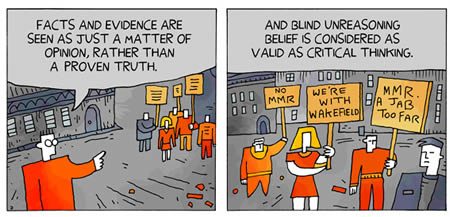
Since Trump, who seems to share Wakefield’s anti-vaxx stance, has become president of the US, Wakefield has managed to creep back in the limelight. The Guardian recently reported: At one of President Trump’s inaugural balls in January last year, he was quoted as contemplating the overthrow of the (pro-vaccine) US medical establishment in words that brought to mind Trump himself. “What we need now is a huge shakeup at the Centers for Disease Control and Prevention (CDC) – a huge shakeup. We need that to change dramatically.”

In the US, Wakefield also founded the ‘Autism Media Channel’ which makes videos alleging a causal link between autism and the MMR vaccine. The film ‘Vaxxed’ was thus directed by Wakefield. It was put forward to premiere at the 2016 Tribeca film festival by Robert De Niro, the father of an autistic child. It alleges a cover-up of the alleged link between MMR and autism by the CDC – the institute Wakefield said needed a shake-up at the Trump inaugural ball. After much discussion, De Niro fortunately withdrew the film.
Wakefield’s private life has also seem significant changes. He is reported to have recently left his wife who had supported him throughout the debacle in the UK and is now ‘deliciously in love’ with the super-model and entrepreneur Elle Macpherson . Brian Burrowes, 48, who edited ‘Vaxxed’ was reported stating that he and Macpherson had begun dating after they were both guests at the ‘Doctors Who Rock‘ Awards in November last year. This event was to honour alternative medicine practitioners, with Macpherson handing out an award and Wakefield receiving one. Other awardees included Del Bigtree and Billy DeMoss DC.
Wakefield’s legacy in Europe is the recurrence of measles due to persistent doubts in vaccination safety. This regrettable phenomenon is fuelled by Wakefield’s multiple activities, including face-book, twitter and you-tube. Social media has provided an alternative to the “failings of mainstream media”, Wakefield was quoted in the Guardian saying – another phrase that could have come from a tweet by the US president himself. “In this country, it’s become so polarised now … No one knows quite what to believe,” Wakefield said. “So, people are turning increasingly to social media.”
And this is what I said about this strategy in today’s Times: “Such anti-vaccination propaganda is hugely harmful. It prompts many families to shun immunisations which means firstly they are unprotected, and secondly we as a people might lose herd immunity. The result is what we currently see throughout Europe: epidemics are threatening the lives of millions. It is in my view irresponsible for any institution to get involved in the anti-vaxx cult, particularly for universities who really should know better.”
On this blog, we constantly discuss the shortcomings of clinical trials of (and other research into) alternative medicine. Yet, there can be no question that research into conventional medicine is often unreliable as well.
What might be the main reasons for this lamentable fact?
A recent BMJ article discussed 5 prominent reasons:
Firstly, much research fails to address questions that matter. For example, new drugs are tested against placebo rather than against usual treatments. Or the question may already have been answered, but the researchers haven’t undertaken a systematic review that would have told them the research was not needed. Or the research may use outcomes, perhaps surrogate measures, that are not useful.
Secondly, the methods of the studies may be inadequate. Many studies are too small, and more than half fail to deal adequately with bias. Studies are not replicated, and when people have tried to replicate studies they find that most do not have reproducible results.
Thirdly, research is not efficiently regulated and managed. Quality assurance systems fail to pick up the flaws in the research proposals. Or the bureaucracy involved in having research funded and approved may encourage researchers to conduct studies that are too small or too short term.
Fourthly, the research that is completed is not made fully accessible. Half of studies are never published at all, and there is a bias in what is published, meaning that treatments may seem to be more effective and safer than they actually are. Then not all outcome measures are reported, again with a bias towards those are positive.
Fifthly, published reports of research are often biased and unusable. In trials about a third of interventions are inadequately described meaning they cannot be implemented. Half of study outcomes are not reported.
END OF QUOTE
Apparently, these 5 issues are the reason why 85% of biomedical research is being wasted.
That is in CONVENTIONAL medicine, of course.
What about alternative medicine?
There is no question in my mind that the percentage figure must be even higher here. But do the same reasons apply? Let’s go through them again:
- Much research fails to address questions that matter. That is certainly true for alternative medicine – just think of the plethora of utterly useless surveys that are being published.
- The methods of the studies may be inadequate. Also true, as we have seen hundreds of time on this blog. Some of the most prevalent flaws include in my experience small sample sizes, lack of adequate controls (e.g. A+B vs B design) and misleading conclusions.
- Research is not efficiently regulated and managed. True, but probably not a specific feature of alternative medicine research.
- Research that is completed is not made fully accessible. most likely true but, due to lack of information and transparency, impossible to judge.
- Published reports of research are often biased and unusable. This is unquestionably a prominent feature of alternative medicine research.
All of this seems to indicate that the problems are very similar – similar but much more profound in the realm of alternative medicine, I’d say based on many years of experience (yes, what follows is opinion and not evidence because the latter is hardly available).
The thing is that, like almost any other job, research needs knowledge, skills, training, experience, integrity and impartiality to do it properly. It simply cannot be done well without such qualities. In alternative medicine, we do not have many individuals who have all or even most of these qualities. Instead, we have people who often are evangelic believers in alternative medicine, want to further their field by doing some research and therefore acquire a thin veneer of scientific expertise.
In my 25 years of experience in this area, I have not often seen researchers who knew that research is for testing hypotheses and not for trying to prove one’s hunches to be correct. In my own team, those who were the most enthusiastic about a particular therapy (and were thus seen as experts in its clinical application), were often the lousiest researchers who had the most difficulties coping with the scientific approach.
For me, this continues to be THE problem in alternative medicine research. The investigators – and some of them are now sufficiently skilled to bluff us to believe they are serious scientists – essentially start on the wrong foot. Because they never were properly trained and educated, they fail to appreciate how research proceeds. They hardly know how to properly establish a hypothesis, and – most crucially – they don’t know that, once that is done, you ought to conduct investigation after investigation to show that your hypothesis is incorrect. Only once all reasonable attempts to disprove it have failed, can your hypothesis be considered correct. These multiple attempts of disproving go entirely against the grain of an enthusiast who has plenty of emotional baggage and therefore cannot bring him/herself to honestly attempt to disprove his/her beloved hypothesis.
The plainly visible result of this situation is the fact that we have dozens of alternative medicine researchers who never publish a negative finding related to their pet therapy (some of them were admitted to what I call my HALL OF FAME on this blog, in case you want to verify this statement). And the lamentable consequence of all this is the fast-growing mountain of dangerously misleading (but often seemingly robust) articles about alternative treatments polluting Medline and other databases.
This study examined websites of naturopathic clinics and practitioners in the provinces of British Columbia and Alberta, looking for the presence of discourse that may contribute to vaccine hesitancy, and for recommendations for ‘alternatives’ to vaccines or flu shots.
Of the 330 naturopath websites analysed, 40 included vaccine hesitancy discourse and 26 offered vaccine or flu shot alternatives. Using these data, the authors explored the potential impact such statements could have on the phenomenon of vaccine hesitancy.
Next the researchers considered these misrepresentations in the context of Canadian law and policy, and outlined various legal methods of addressing them. They concluded that tightening advertising law, reducing CAM practitioners’ ability to self-regulate, and improving enforcement of existing common and criminal law standards would help limit naturopaths’ ability to spread inaccurate and science-free anti-vaccination and vaccine-hesitant perspectives.
The paper listed some poignant examples of vaccine hesitancy discourse:
1) ‘…children are now being given increasing numbers of vaccinations containing potentially harmful derivatives and substances such as mercury, thimerisol [sic], aluminum and formaldehydes. These harmful derivatives can become trapped in our tissues, clogging our filters and diminishing one’s ability of further toxins out.’ — www.evolvenaturopathic.com
2) ‘Vaccines given to children and adults contain mercury and aluminum. Babies are especially susceptible to small amounts of mercury injected directly into their tiny bodies. It is now suspected that the increase in autism and Asperger Syndrome is related to the mercury in childhood vaccinations.’ — www.vancouvernaturopathicclinic.com
3) ‘The conventional Flu Shot is a mixture of 3 strains of flu viruses mixed with a number of chemical preservatives and these strains are based on a prediction of what flu viruses some medical experts think will be the most problematic this season. This is really an impossible prediction to make when we have thousands of different strains of viruses that are continuously mutating.’ — www.advancednaturopathic.com
4) ‘A [sic] epidemiologist researcher from British Columbia, Dr. Danuta Skowronski, published a study earlier this year showing that people who were vaccinated consecutively in 2012, 2013 and 2014 appeared to have a higher risk of being infected with new strains of the flu.’ — www.drtas.ca
5) ‘Increasing evidence suggests that injecting a child with nearly three dozen doses of 10 different viral and bacterial vaccines before the age of five, while the immune system is still developing, can cause chronic immune dysfunction. The most that vaccines can do is lead to an increase in antibodies to a specific disease.’ — www.evolvevitality.com
6) ‘The bugs in question (on the Canadian Vaccine List) can enter our systems and depending on our bodies, our histories, and mostly the bugs’ propensity, they can cause serious harm. There are certainly questionable ingredients in vaccines that have the potential to do the same.’ — www.tharavayali.ca
The authors also considered that, in Canada, a naturopath who recommends homeopathic vaccines or who counsels against conventional vaccination could potentially be criminally negligent. Section 219 of the Criminal Code of Canada [Code] states that ‘[e]very one is criminally negligent who, in doing anything, or in omitting to do anything that it is his duty to do, shows wanton or reckless disregard for the lives or safety of other persons’. Subsection (2) goes on to state that, for the purposes of criminal negligence, ‘duty’ means a duty imposed by law; a legal duty in this context is one arising from statute or from the common law. The Code creates a legal duty for anyone ‘who undertakes to administer surgical or medical treatment to another person or to do any other lawful act that may endanger the life of another person’ to ‘have and to use reasonable knowledge, skill and care in so doing’. This duty is a uniform standard, meaning the requirement of reasonable knowledge, care, and skill is based on the treatment or lawful act in question, not on the level of experience of the person administering it. As such, naturopaths offering services similar to medical doctors will be held to the same standards under the Code.
Criminal negligence occurs due to the ‘failure to direct the mind to a risk of harm which [a] reasonable person would have appreciated’. Fault is premised on the wrongful act involved, rather than the guilty mind of the perpetrator. Naturopaths counseling patients against vaccination are arguably undertaking a lawful act that endangers the life of another person (especially in the case of a young child, elderly individual, or immunocompromised person), breaching s.216 of the Code. In addition, since relevant legal duties include those arising through the common law, naturopaths could alternatively be criminally negligent for failing to satisfy the aforementioned duty of reasonable disclosure inherent to standard of care in tort. In the context of a community with diminished vaccination rates, either failure could be considered wanton or reckless, as it may greatly and needlessly endanger the patient. However, under the standard for criminal negligence, the trier of fact must ‘assess whether the accused’s conduct, in view of his or her perception of the facts, constituted a marked and substantial departure from what would be reasonable in the circumstances’. This is similar to the standard of gross negligence, so ultimately a finding of criminal negligence would require meeting a rather onerous threshold.
______________________________________________________________________________
This, of course, is according to Canadian law; but I imagine that the law in other countries must be similar.
Therefore, this is a legal opinion which might be worth considering also outside Canada.
If there is a legal expert amongst my readers, please do post a comment.
The literature on malpractice in medicine is huge: more than 33 000 articles listed in Medline. By contrast, the literature on malpractice in alternative medicine hardly exists. An exception is this recent article. I therefore thought I share it with you and provide a few comments:
START OF QUOTE
According to the (US) National Practitioner Data Bank, between September 1, 1990 and January 29, 2012, a total of 5,796 chiropractic medical malpractice reports were filed. Lawsuits with the highest payouts in any medical field are related to misdiagnosis, failure to diagnose and delayed diagnosis of a severe medical condition.
Common reasons for chiropractic malpractice lawsuits:
Chiropractor causes stroke: Numerous cases have been documented in which a patient suffers a stroke after getting his or her neck manipulated, or adjusted. Especially forceful rotation of the neck from side to side can overextend an artery that runs along the spine, which can result in a blockage of blood flow to the brain. Strokes are among the most serious medical conditions caused by chiropractic treatment, and can result in temporary or permanent paralysis, and even death.
Herniated disc following adjustment: Although many patients seek the medical attention of a chiropractor after they have experienced a herniated disc, chiropractors can actually be the cause of the problem. Usually a herniated disc is caused by wear and tear, but a sudden heavy strain, increased pressure to the lower back or twisting motions can cause a sudden herniated disc. The stress that chiropractors exercise in their adjustments have been known to be the root cause of some herniated discs.
Sexual misconduct: The American Chiropractic Association has assembled a code of ethics “based upon the acknowledgement that the social contract dictates the profession’s responsibilities to the patient, the public and the profession.” Sexual misconduct is among the top ten reasons that patients file lawsuits against chiropractors. Often, chiropractic practices are unfamiliar to many new patients and can be misinterpreted as inappropriate even though they are absolutely normal, so it is important that patients familiarize themselves with common chiropractic methods of healing.
END OF QUOTE
In this context, a study of chiropractic from Canada might be interesting. It highlights the conclusions from Canadian courts: informed consent is an ongoing process that cannot be entirely delegated to office personnel… A further study showed that valid consent procedures are either poorly understood or selectively implemented by chiropractors. Arguably, not obtaining informed consent amounts to malpractice.
In our book, this is what we conclude about informed consent by alternative therapists in general: Genuine informed consent is unattainable for most CAM modalities. This presents a serious and intractable ethical problem for CAM practitioners. Attempts to square this circle by watering down or redefining the criteria for informed consent are ethically indefensible. The concept of informed consent and its centrality in medical ethics therefore renders most CAM practice unacceptable. Conventional healthcare subscribes to the ethical principle ‘no consent, no treatment’: we are not aware of the existence of any good reasons to excuse CAM from this dictum.
I fear that, if we were to count the lack of informed consent by chiropractors (and other alternative practitioners) as malpractice, the numbers would be astronomical. Or, to put it differently, the often-cited relatively low malpractice rate in chiropractic is due to the omission of the vast majority of malpractice cases.