Monthly Archives: November 2024
If you live in the UK, you could not possibly escape the discussion about the ‘Assisted Dying Bill’ which passed yesterday’s vote in the House of Commons (MPs have voted by 330 to 275 in favour of legalising voluntary assisted suicide). Once the bill passed all the further parliamentary hurdles – which might take several years – it will allow terminally ill adults who are
- expected to die within six months,
- of sound mind and capable of managing their own affairs
to seek help from specialised doctors to end their own life.
After listening to many debates about the bill, I still I have serious concerns about it. Here are just a few:
- Palliative care in the UK is often very poor. It was argued that the bill will be an incentive to improve it. But what, if this is wishful thinking? What if palliative care deteriorates to a point where it becomes an incentive to suicide? What if the bill should even turn out to be a reason for not directing maximum efforts towards improving palliative care?
- How sure can we be that an individual patient is going to die within the next six months? Lawmakers might believe that predicting the time someone has left to live is a more or less exact science. Doctors (should) know that it is not.
- How certain can we be that a patient is of sound mind and capable of managing their own affairs? By definition, we are dealing with very ill patients whose mind might be clouded, for example, by the effects of drugs or pain or both. Lawmakers might think that it is clear-cut to establish whether an individual patient is compos mentis, but doctors know that this is often not the case.
- In many religions, suicide is a sin. I am not a religious person, but many of the MPs who voted for the bill are or pretend to be. Passing a law that enables members of the public to commit what in the eyes of many lawmakers must be a deadly sin seems problematic.
In summary, I feel the ‘Assisted Dying Bill’ is a mistake for today; it might even be a very grave mistake for a future time, if we have a government that is irresponsible, neglects palliative care even more than we do today and views the bill as an opportunity to reduce our expenditure on pensions.
THE TIMES recently published an interview with (my ex-friend) Michael Dixon, a person who has featured regularly on this blog. Here is a short passage relevant to our many discussions about homeopathy:
“Can I say on the record I’ve never studied homeopathy,” he says. “I’ve never even offered homeopathy. What I have done is said that if patients feel they’ve benefited from homeopathy, what’s the problem?”
The problem, scientists would argue, is that homeopathy undermines trust in real, evidence-based medicine. Homeopathic remedies are made by diluting active ingredients in water, often so that none of the original substance remains. Homeopathy has been banned on the NHS since 2017, because it is “at best a placebo”.
For Dixon, however, this “trench warfare” divide between alternative and conventional medicine is too binary. Even if something is scientifically impossible, as long as it helps his patients that is all that matters, Dixon says. “Many years ago, a Christian faith healer started seeing some of my patients. She made a lot of them better. I didn’t care a damn if it’s placebo — they got better,” he says.
While he thinks homeopathy can serve a purpose on the NHS, he draws a line at the “madness of some of the more wayward complementary practitioners” who will argue for using homeopathy to vaccinate children. “I would always advocate against anyone going for complementary medicine if there’s good evidence-based conventional medicine.”
Apart from
- the hilarious implication that a faith healer is NOT a “wayward practitioner”,
- the fact that, as far as I know, nobody ever claimed that Dixon studied homeopathy,
- the fact that Dixon does not understand what, according to scientists, the problems with homeopathy are,
his statements seem very empathetic at first glance.
Dixon’s key argument – if patients feel they’ve benefited from homeopathy, why not prescribe it – is an often-voiced notion. But that does not make it correct!
A physician’s duty is not primarily to please the patient. His/her duty foremost is to behave responsibly and to treat patients in the most effective way. And this includes, in a case where the patient feels to have benefitted from a useless or dangerous treatment, to inform the patient about the current best evidence. To me, this is obvious, to others, including Dixon, it seems not. Let me therefore ask you, the reader of these lines: what is the right way to act as a GP?
SCENARIO DIXON
Patient wants a treatment that is far from optimal and claims to have experienced benefit from it. The GP feels this is enough reason to prescribe it, despite plenty of evidence that shows the treatment in question has at best a placebo effect. Thus the doctor agrees to his/her patient taking homeopathy.
SCENARIO ERNST
Patient wants a treatment that is far from optimal and claims to have experienced benefit from it. The doctor takes some time to explain the the therapy is not effective and that, for the patient’s condition, there are treatments that would be better suited. The patient reluctantly agrees and the doctor prescribes a therapy that is backed by sound evidence (in case the patient resists, he/she is invited to see another doctor).
I admit that risking to lose a patient to another colleague is not an attractive prospect, particularly if the patient happens to be your King. But nobody ever said that medicine was easy – and it certainly is not a supermarket were customers can pick and choose as they please.
What do you think?
A journalist from the DAILY MAIL alerted me to the fact that yet another celebrity having decided to sell dietary supplements, interviewed me on the subject, and eventually published an article about it. One would not have thought that the Beckhams are short of money – so, why did David Beckham turn into a snake-oil salesman? I am far from being able to answer this question. What I now do know is that, via his firm ‘IM8’, he has started marketing two supplements (one of his slogans is ‘Built by Science, Trusted by Beckham’):
Daily Ultimate Essentials: All-in-One Supplement
This is a ‘multi-everything’ supplement. The only truly remarkable thing about it is its price tag. There are hundreds of similar products on the market. Almost all of them are much cheaper, and none is helpful for anyone who is healthy and consumes a balanced diet, as far as I can see.
Daily Ultimate Longevity: Healthy Aging
The implication here seems to be not a trivial one; the name clearly implies that we live longer, if we regularly bought this supplement. Not onlly that, we would also be healthier! I can see no evidence for either of these claims, yet a simple calculation tells me that we would be considerably poorer, if we fell for this advertising gimmick.
On the website, we learn a bit more:
At IM8, our commitment to science goes beyond innovation—it’s the foundation of everything we do. A world-class team of experts from space science, medicine, and academia has united with one goal: to revolutionize wellness. We’ve pioneered CRT8™ (Cell Rejuvenation Technology 8), designed to enhance cellular rejuvenation and push the limits of what’s possible in health.
Each of our products undergoes rigorous third-party testing and clinical trials, ensuring purity, efficacy, and results you can trust. With IM8, you’re getting scientifically driven core nutrition for optimal health and longevity.
___________________
I feel embarrassed for the ‘world-class team of experts from space science, medicine, and academia’ who give their good name to this hyped up nonsense. Moreover, I ask myself whether David Beckham’s new attempt to increase his wealth might be a case for the Advertising Standards Authority (ASA).
The alleged harm of Covid-vaccinations is a topic that still leads to misunderstandings, perhaps nowhere more than in the realm of so-called alternative medicine. Therefore, this paper seems relevant.
The first dose of COVID-19 vaccines led to an overall reduction in cardiovascular events, and in rare cases, cardiovascular complications. There is less information about the effect of second and booster doses on cardiovascular diseases. Using longitudinal health records from 45.7 million adults in England between December 2020 and January 2022, this study compared the incidence of thrombotic and cardiovascular complications up to 26 weeks after first, second and booster doses of brands and combinations of COVID-19 vaccines used during the UK vaccination program with the incidence before or without the corresponding vaccination.
The incidence of common arterial thrombotic events (mainly acute myocardial infarction and ischaemic stroke) was generally lower after each vaccine dose, brand and combination. Similarly, the incidence of common venous thrombotic events, (mainly pulmonary embolism and lower limb deep venous thrombosis) was lower after vaccination. There was a higher incidence of previously reported rare harms after vaccination: vaccine-induced thrombotic thrombocytopenia after first ChAdOx1 vaccination, and myocarditis and pericarditis after first, second and transiently after booster mRNA vaccination (BNT-162b2 and mRNA-1273).
The authors concluded that these findings support the wide uptake of future COVID-19 vaccination programs.
The authors stress that their study has several limitations.
- First, residual confounding, including that linked to delayed vaccination in high-risk individuals, may persist despite extensive adjustments for available covariates. We were able to identify some, but not all people who were clinically vulnerable (and hence might have been eligible for earlier vaccination): for example, younger adults in long-stay settings could not be reliably identified.
- Second, we did not adjust for potential confounding by time-varying post-baseline factors that may have influenced receipt of vaccination and the outcomes of interest: for example, development of respiratory symptoms or being admitted into hospital leading to postponement of vaccination. Such confounding may explain estimated lower hazard ratios soon after vaccination.
- Third, ascertainment of some outcomes may have been influenced by public announcements from regulatory agencies, such as the European Medicines Agency Pharmacovigilance Risk Assessment Committee announcement or the CDC announcement on myocarditis. This was addressed in sensitivity analyses for myocarditis and pericarditis, censoring follow-up at the time of public announcements of these adverse effects of vaccination, although the shorter follow-up times and corresponding smaller numbers of events in the restricted analyses meant that aHRs were estimated with reduced precision.
- Fourth, outcomes may be underreported, particularly from people in nursing homes or among those with severe health conditions, due to diagnostic challenges; also, routine electronic health records, not intended for research, may under-ascertain less severe, non-hospitalised events. Both forms of potential underreporting, however, are expected to be uncommon for hospitalised thrombotic events.
- Fifth, we restricted follow-up to 26 weeks after vaccination to prevent an influence of subsequent vaccinations on estimated associations and limit the impact of delayed vaccination on our findings. Horne et al. demonstrated selection bias in estimated HRs for non-COVID-19 death arising from deferred next-dose vaccination in people with a recent confirmed COVID-19 diagnosis or in poor health.
- Sixth, we did not address long-term safety of vaccination, or the impact of subsequent booster doses.
Nonetheless, this study offers reassurance regarding the cardiovascular safety of COVID-19 vaccines, with lower incidence of common cardiovascular events outweighing the higher incidence of their known rare cardiovascular complications. No novel cardiovascular complications or new associations with subsequent doses were found. These findings support the wide uptake of future COVID-19 vaccination programs. The authors express their hope that this evidence addresses public concerns, supporting continued trust and participation in vaccination programs and adherence to public health guidelines.
Will the evidence convince the notorious anti-vaxers that regularly comment on my blog?
I very much doubt it – not because of the limitations of the study but because of the fact that anti-vaxers seem to be immune to any evidence that is out of line with their beliefs and conspiracy theories.
“As a medical doctor having taken care of thousands of patients in my life, I strive to ensure the health safety and superior wellbeing of my patients. I continue to encourage, educate and inform not only my patients, but the public to stay strong and healthy any time, not just during a pandemic. Our body is our temple and what we put in it and what we don’t affects the way we feel, think and function. Essential vitamins and minerals are key component to daily functioning but thats not always possible in this day and age with our busy hectic lifestyles, so after years of educating my patients, now I made it a little easier to get all the nutrition you need to live strong and stay healthy.”
These are the words from an advertisement for “Immune System Support for your Active Life” sold by Dr. Janette Nesheiwat who was just nominated as Donald Trump’s next SURGEON GENERAL. Amongst other items, she sells 60 capsules of ‘B+C BOOST Plus D3 & Zinc‘ for US$26.99.
Her website describes the new US Surgeon General as follows:
Dr. Janette Nesheiwat is a top Family and Emergency Medicine doctor. She brings a refreshingly no-nonsense attitude to the latest medical news, breaking down everything you need to know to keep you- and your family- healthy at all times.
Whether caring for her patients in the ER, serving on the front lines of disaster relief with the Red Cross, or sharing need-to-know info with TV audiences, Dr. Nesheiwat’s mission is not only to save lives—but to change them, by giving real people the treatment and the expertise they need.
Her sincere and straightforward approach is a product of her background. She was one of five kids raised by a widowed mother, and also completed US Army ROTC Advanced Officer Training in Ft. Lewis, Washington prior to becoming a Family and Emergency Physician. She has led medical relief missions around the globe and today she is a medical news correspondent and the Medical Director at CityMD.
I was always telling my patients who were unwell drink some tea, take some vitamin b12 and vitamin C. I found myself repeating my all natural regimen to my patients over and over “take some B12 and C to Boost” your immune system. Thats how I came up with BC Boost. Although I am a doctor, I am not quick to prescribe drugs unless I feel necessary as we want to put into our body the most natural wholesome ingredients.
Vitamin B12 is a cofactor in DNA synthesis. It helps maintain healthy blood cells and nerve function as well as prevent anemia which causes fatigue, a common complaint in those who are sick, tired, run down. Vitamin C is needed for development of collagen and a strong immune system as well as body repair and growth.
Yes, you are quite right, Dr. Nesheiwat might have forgotten one or two not-so-unimportant details:
- If you eat a healthy diet, you don’t need vitamins.
- If you do need vitamins, you can buy them cheaper elsewhere.
- These vitamins do not boost your immune system.
- Boosting the immune system could actually do a lot of harm to the many people suffering from auto-immune diseases.
But never mind, we can nevertheless be confident that Dr. Nesheiwat will bring great joy to the US supplement industry. I am less confident, however, that she did public health a great service when, in her role as a regular ‘Fox News’ commentator, she warned that wearing face masks during the pandemic exposed consumers to toxic substances linked to seizures and cancer.

Dry needling (DN) is a treatment used by various healthcare practitioners, including physical therapists, physicians, and chiropractors. It involves the use of either solid filiform needles or hollow-core hypodermic needles for therapy of muscle pain, including pain related to myofascial pain syndrome. DN is mainly used to treat myofascial trigger points, but it is also used to target connective tissue, neural ailments, and muscular ailments. There is conflicting evidence regarding the effectiveness of DN for any condition.
Orofacial pain (OFP) typically has a musculoskeletal, dental, neural, or sinogenic origin. Our systematic review was aimed at evaluating the evidence base for the effectiveness of DN for OFP.
We searched Medline, Cochrane Central, and Web of Science (from their respective inceptions to February 2024) for RCTs evaluating the effectiveness of DN in patients with OFP. Studies with patients suffering from cervicogenic or tension type headaches as well as observational studies were excluded. Primary outcomes were pain intensity and severity; secondary outcomes were disability, quality of life, and adverse effects (AEs). The review adhered to the methods described by in the Cochrane Handbook.
Twenty-four RCTs with a total of 1,318 patients suffering from OFP could be included. Most had an unclear or high risk of bias, and the quality of the evidence ranged from very low to low for all comparisons and outcomes. A meta-analysis suggested that, compared with usual care alone, DN + usual care had no effect on pain intensity (visual analogue scale) (standardized mean difference = −1.89, 95% confidence intervals −5.81 to 2.02, very low certainty evidence) at follow-ups of up to 6 weeks. Only 6 RCTs (25%) mentioned AEs, and none of them reported that AEs had occurred. The remaining 18 (75%) studies failed to report AEs.
We concluded that DN cannot be considered as an effective treatment option for OFP. This is due to the uncertainties of the available evidence. We believe that larger, rigorous, and better reported trials with more homogeneous comparators might potentially reduce the current uncertainties. Such trials should strictly adhere to the classifications provided by the International Headache Society and published in the International Classification of Orofacial Pain.
Yet again, I need to stress that the vast majority od RCTs failed to mention AEs. When will the last (pseudo-) researcher have learnt that the non-reporting of AEs is a violation of research ethics?
I don’t normally report personal things but today I will make an exception. This story is simply too good to ignore.
A French friend of mine was recently looking to employ a new secretary. She short-listed and interviewed 10 candidates. To her surprise (and amusement), 5 of the 10 had some sort of ‘medical’ diploma. Since she knows of my interest in so-called alternative medicine (SCAM), she emailed me their qualifications:
An energy therapist
A practitioner of Acess Bars
A practitioner of the Enelph method
A facial reflexologist
A practitioner of light therapy
In case you don’t know what these titles mean – I too did not know of some of them – here are the definitions I found after a few quick searches:
Energy healing is a complementary approach based on the belief that our bodies have energy flowing through them, and that healing can come from helping to balance this flow
Access Bars are 32 points on your head that, when gently touched, effortlessly and easily release the thoughts, ideas, beliefs, emotions, and considerations that stop you from creating a life you love. Access Bars are used as a potent and pragmatic tool by families, wellness practitioners, schools, businesses, mental health professionals, athletes, prisons, veterans, artists, and many more. Access Bars can feel like hitting the delete button on your computer’s cluttered hard drive – only this time, you’re creating space in your brain. Things like negative thought patterns, or that endless mental chatter keeping you awake at night, can be released and make space for the calm you’ve been seeking.
The Enelph Method is a holistic healing method, using an energy rebalancing technique. Its ultimate goal is to help establish inner peace and harmony within individuals, which can then manifest externally to gradually facilitate awakening both individually and collectively. It is part of an immense aid package offered to us by guides from other dimensions in order to awaken consciousness on the planet .
Facial Reflexology works on the same principle as the feet. It focuses on the reflex points on the face to stimulate the body’s healing mechanisms which improve circulation and encourage the release and removal of toxins from the body via the lymphatic system. Reflex points in the face connect to and help balance the whole body.
Light therapy, also known as phototherapy and bright light therapy, is a therapy used to treat a variety of mental health conditions. Primarily, it’s used to treat a common type of depression called seasonal affective disorder (SAD), which is also known as the winter blues or seasonal depression. Light therapy may also be helpful as a therapy for sleep disorders, other forms of depression, and more.
Except for light therapy, I am unable to find any reliable evidence that these treatments do more good than harm.
Why do I find this amusing?
It suggests, I think, that France is awash with SCAM (this is also my impression whenever I spend some time in France). Not only that, it also implies that many women get lured into obtaining (frequently expensive) diplomas for profoundly useless therapies, only to find later that they are unable to earn a living with them. Thus they eventually find themselves applying for a secretarial post.
I therefore feel that my little anecdote is both amusing and sad. My hope is that my friend’s little story might deter people from paying good money for phoney SCAM diplomas!
PS
I was told that the above-mentioned secretarial post was given to a person without a pseudo-medical diploma.
It has been reported that the Dresden Higher Regional Court (OLG) examined the extent to which a doctor must inform his patient, if he/she uses so-called alternative medine (SCAM) that deviates from conventional medicine. To be precise, the case was about a detoxification therapy with so-called chelating agents. A patient had received ‘holistic treatment’ for symptoms of exhaustion with sleep disorders, headaches, concentration problems and general restlessness and became worse and worse during the course of the therapy. Eventually, he sued for compensation for pain and suffering and damages.
Initially, the patient had been treated conservatively with iron supplements. After carrying out ‘provocation test’, the doctor diagnosed a heavy metal load, which he treated with ‘elimination therapy’ in the form of an i.v. “detox therapy” (2-3-dimercaptopropane-1-sulfonate (DMPS)). The patient subsequently became increasingly unwell, leading to hospitalisation and treatment for severe thrombocytopenia with moderate liver damage.
The expert opinion obtained in the first-instance of the ensuing legal proceedings considered the cause of the patient’s complaints to be the administration of an inadmissibly excessive amount of alpha-lipoic acid during ‘detoxification therapy’. It became clear that the doctor had not properly informed the patient about this therapy and its risks.
The court considered that the basic information required under German law had not been provided. This basic information gives the patient a general idea of the severity of the procedure and the impact of the associated burdens on their lifestyle. The obligation to provide information also applies to practitioners who use SCAM. A doctor who offers SCAM must therefore clearly inform the patient that they are deviating from a conventional approach. He/she must also explain why he/she is doing this and what advantages and disadvantages the patient can expect as a result.
Detoxification therapy is indisputably such a SCAM, the costs of which are not covered by the health insurance companies. The patient must therefore not only be informed of the risks and the danger of failure of the procedure, but must also be informed that the planned therapy is not standard medical practice and that the effectiveness of the therapy is unproven.
The patient must be able to weigh up whether they want to take the risks of treatment with regard to the prospects of success in view of their state of health before the procedure. Such information was not provided in the present case. For this reason, the Regional Court awarded damages for pain and suffering amounting to EUR 15,000 for the damage to health suffered.
__________________________
On this blog, we have often discussed the problems of informed consent. Informed consent, I have previously stated, must usually include full information on:
- the diagnosis
- its natural history
- the most effective treatment options available
- the proposed therapy
- its effectiveness
- its risks
- its cost
- a rough treatment plan
Only when this information has been transmitted to and understood by the patient can informed consent be considered complete. I do understand why many SCAM practitioners do not like informed consent – it could stop many from practising: they are frequently unable to provide the required information. Yet, ALL clinicians have a moral, ethical and legal duty to obtain informed consent BEFORE starting a therapy. It is reassuring that the German court agrees.
The Bavarian homeopathy study has been aborted!
As I posted in 2019, the Bavarian government has given the go-ahead to a major study of homeopathy.
The study was aimed at clarifying whether the use of homeopathic remedies can reduce the use of antibiotics in humans and animals. The vote was carried because of the CDU delegates being in favour. The debate of the project was, however, controversial. Critics stressed that, at best, the study is superfluous and pointed out that the project is negligent because it implies that homeopathics might be effective, whereas the evidence shows the opposite. A SPD delegate stated that he is ‘open moth’, homeopathy works because of the doctor-patient contact and not because of its remedies which are pure placebos. The project was tabled because some people had worried about antibiotic resistance and felt that homeopathy might be an answer. Some CSU delegates stated that in ENT medicine, there is evidence that homeopathics can reduce the use of antibiotics. Even in cases of severe sepsis, there was good evidence, they claimed.
The FRANKFURTER ALLGEMEINE just reported more details about this remarkable project and its failure to produce meaningful results:
The double-blind, placebo-controlled RCT carried out at the Technical University of Munich examined women with regular urinary tract infections – all were to be given antibiotics or ibuprofen if necessary. Around 120 of the women were to receive either placebo or individually selected globules as a preventative measure. Differences were to be measured by whether infections occurred less frequently in the globule group and whether antibiotics were necessary.
The results should have been available a long time ago. However, as the lead-investigator of the study, nephrologist Lutz Renders, has now revealed that the study has apparently come to nothing. ‘The study has cancelled recruitment because the required number of test subjects could not have been reached within a reasonable period of time,’ he explains. Only the women who have already been included will now be followed up until the beginning of 2025.
‘Of the 200 or so women who registered, around 40 were found to have urinary tract infections’, says Renders, ‘so that they could be included in the study. It is a pity that the actual aim of the study was not achieved, as it is possible that something could be learnt about urinary tract infections in general from the extensive examinations of the women. I don’t have much to do with homeopathy,’ says Renders.
Georg Schmidt, head of the ethics committee at the Technical University of Munich, says that the committee found it ‘extremely difficult’ to authorise the study at all. ‘We had a heated discussion along the lines that you can’t compare nothing with nothing. We all agreed that homeopathy is ineffective.’ The commission decided to ensure that the risk of a false-positive result is as low as possible – the statistics have been tightened up for this purpose’.
___________________________
The notion that a definitive test of homeopathy is needed seems to beset German govenments from time to time – the last such initiative occurred during the Third Reich. Perhaps, one day, even politicians will understand that, on the scientific level, the discussion about homeopathy is now well and truly over, and that no more money needs to be wasted on it?
Donald Trump has nominated Dr. Mehmet Oz, a celebrity physician known for his US television show, to lead the Centers for Medicare and Medicaid Services (CMS). Some 20 years ago, I had the pleasure to briefly meet Oz at a conference. I can honestly say that I rarely met anyone who was – in my view – oozing that much quackery as he was. Oz’s nomination has sparked (not just my but) widespread disbelief, mainly due to Oz’s long history of irresponsibly promoting even the worst forms of so-called alternative medicine (SCAM) for his own fame and fortune.
After being nominated, Oz posted a comment on X: “I am honored to be nominated by @realDonaldTrump to lead CMS. I look forward to serving my country to Make America Healthy Again under the leadership of HHS Secretary @RobertKennedyJr“
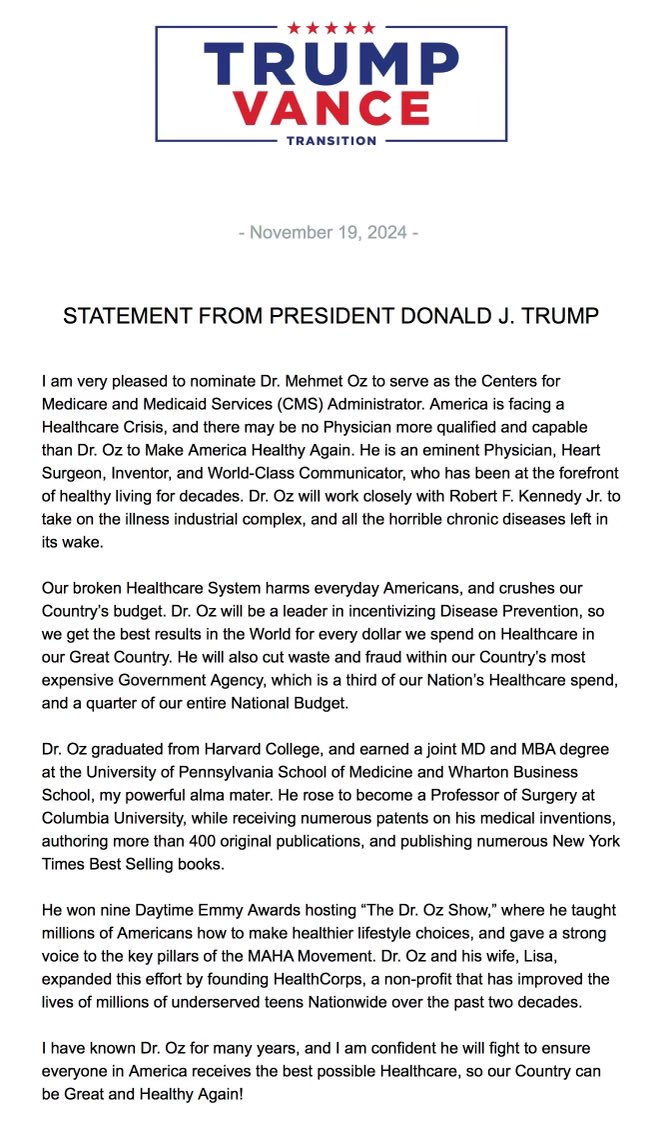
Personally, I am beginning to find Trump’s recent appointments too tiresome and ridiculous for further detailed comments. They seem to me like a deliberate provocation and an indication of the systematic destruction that Trump has in mind for his second term in office.
Instead of a comment, let me therefore show you some of the comments on the appointment that have appeared on X.
- Robert F. Kennedy Jr @RobertKennedyJr Very excited that my friend @DrOz has agreed to run CMS. Thank you @realDonaldTrump for this outstanding nomination. Welcome Dr. Oz to The Avengers. Let’s Make America Healthy Again!
- Elizabeth Warren @SenWarren Running Medicare and Medicaid for over 100 million Americans isn’t like hosting a daytime talk show. Dr. Oz is another rich guy who doesn’t care if your health care costs go up or an insurance company denies you coverage. These decisions have life and death consequences.
- Billboard Chris @BillboardChris Dr. Oz has been appointed to head Medicare and Medicaid. He needs to come out and publicly disavow this abhorrent garbage he pushed on his show about ‘transgender children.
- Michael Steele @MichaelSteele Robert F. Kennedy at HHS; now Dr. Mehmet Oz to run Medicare and Medicaid. And Republicans want to cut the social safety net to pay for renewing Trump’s tax cuts. Reality TV personalities for a Reality TV administration. Unfortunately, we live in a world where diseases are real, people are poor and reality hits many of us hard every day
- The Resistor Sister @the_resistor More like The Apprentice Administration NONE of them are qualified.
- seanmack @seanmack1025 When does Dr Doolittle get a job. I bet doctor Phil feels left out.
- Peter Morley @morethanmySLE Donald Trump’s CMS pick Dr. Mehmet Oz suggested in 2020 Lupus patients were IMMUNE to COVID if we took Hydroxychloroquine. FACT: I have Lupus & have been on this since medication since 2014 & I had Covid 3x. This man should NOT be overseeing Medicare & Medicaid!
___________________________________________
The bon mot that describes the situation best: If you put a clown in a palace, the clown does not become a king, but the palace turns into a circus.