Yes, I have published another book!
It is about the Third Reich; more specifically, it is about Austria’s medical profession during that period. As the book is in German, allow me to translate the concluding chapter for readers who don’t speak this language:
“The revulsion at what … has happened cannot be put into words at all. One can only list the examples, as if they were entries in a catalogue, statistical data, items in a register. In a register of sins, in the register of mortal sins of a criminal regime. These are unprecedented examples. The murderers were animals who believed themselves to be human beings. The victims were human beings who were treated as animals.”
These words were written by Erich Kästner. Fearing for his life, he spent the final weeks of the Third Reich in hiding in Austria. He formulated these sentences after hearing, for the first time, the testimony of a survivor of a concentration camp.
My book is, in fact, something like a catalogue as well—a catalogue of biographical sketches of Austrian physicians, most of them psychiatrists, who became guilty in one way or another after the Anschluss. The spectrum of wrongdoing was wide.
Some never got their hands dirty themselves. They were merely “followers” or silent accomplices. Yet as fanatical Nazis, they still did their part to propagate National Socialist ideology. In doing so, they supported the crimes of others and contributed substantially to them, for example: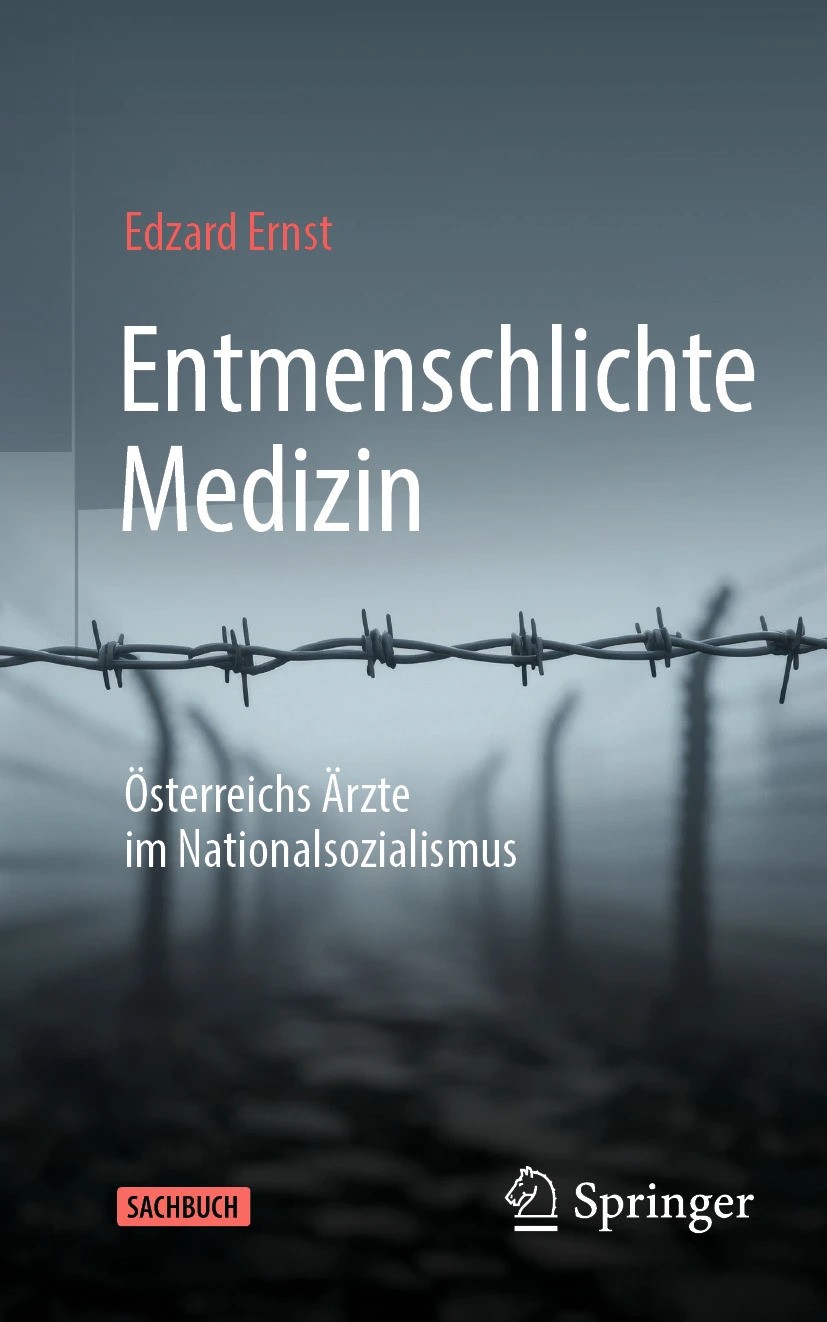
- Breitenecker
- Clara
- Grosser
- Haferl
- Hamperl
- Herbst
- Pichler
- Plattner
- Risak
- Werkgartner
Many of the physicians mentioned in this book abused people in concentration camps in ways worse than animals. Kästner remarked on this: “The camps resembled insane asylums—but in reverse, because it was not the inmates who were mad, but the staff,” for example:
- Begusch
- Beiglboeck
- Ehrenberger
- Eberl
- Fischer
- Frick
- Gross KJ
- Heim
- Joebstl
- Kahr
- Litschel
- Meyer
- Polzer
- Puhr
- Ramsauer
- Richter
- Thurnher
- Wodraska
Numerous physicians managed after the war to evade judicial prosecution or punishment to a large extent, for example:
- Asperger
- Berta
- Birkmayer
- Frick
- Gross KJ
- Hamburger
- Heim
- Hermann
- Hofmann
- Huebsch
- Kahr
- Kaufmann
- Korp
- Meyer
- Pernkopf
- Polzer
- Scharfetter
- Schicker
- Thums
- Thurnher
- Tropper
- E. Tuerk
- Uibarrak
- Utz
- Wodraska
- Vonbun
Some of the physicians discussed in my book were even able, after the end of the Third Reich, to pursue impressive medical careers, for example:
- Asperger
- Berta
- Birkmayer
- Gross H
- Hamperl
- Kaufmann
- Pischinger
- Thums
- Werkgartner
As has already been emphasized repeatedly in various chapters, the prosecution of the perpetrators was, at best, hesitant. After the war, Austria was keen to present itself as a victim; exposing Austrian citizens as accomplices did not serve this narrative. As a result, only a small number of guilty physicians were prosecuted and punished after the war, for example:
- Beiglboeck
- Czermak
- Ehrenberger
- Niedermoser
- Puhr
- Ramsauer
- Rolleder
- M. Tuerk
Some of the guilty physicians were apparently driven by feelings of guilt to evade justice through suicide, for example:
- De Crinis
- Eberl
- Eppinger
- Lonauer
- Richter
- Sorger
My lists are certainly incomplete. During my research, the names of Austrian physicians repeatedly emerged for whom at least suspicions of involvement in Nazi crimes exist. However, because I was able to find only fragmentary material, I refrained from discussing these individuals—whom I estimate to number at least 30 additional physicians—in my book. This, too, highlights the enormous need for further research.
During the Third Reich, around 800,000 people were imprisoned because of their opposition to National Socialism; approximately 90,000 of them perished as a result. Physicians, however, were only very rarely represented in the resistance.
At first glance, this may seem surprising. Physicians could have convincingly invoked their professional ethics to argue that cooperation was impossible. One could argue that doctors, like hardly any other professional group, had a duty to resist crimes against humanity. That this did not happen undoubtedly has complex reasons.
On the one hand, the medical profession already harbored a deeply rooted, strongly conservative tradition before 1933 that was sympathetic to National Socialism or at least not opposed to it. On the other hand, many physicians saw personal or professional advantages in Nazi ideology. Finally, one must consider how systematically, brutally, and ruthlessly the Nazis proceeded against opponents of the regime of all kinds.
It is not the aim of my book to pass judgment on the actions or inaction of physicians during the Third Reich. In my view, moralizing would be neither appropriate nor constructive. Rather, this book is an attempt to document and to understand. My intention is to raise awareness and to preserve the history of medicine in the Third Reich from oblivion. My hope is that remembering it will protect us from ever again embarking on similar paths of delusion.
To conclude, I quote Erich Kästner once more:
“The events from 1933 to 1945 should have been fought no later than 1928. After that, it was too late. One must not wait until the struggle for freedom is called treason. One must not wait until a snowball has turned into an avalanche. One must crush the rolling snowball. No one can stop the avalanche.”

Harken ye Americans.